
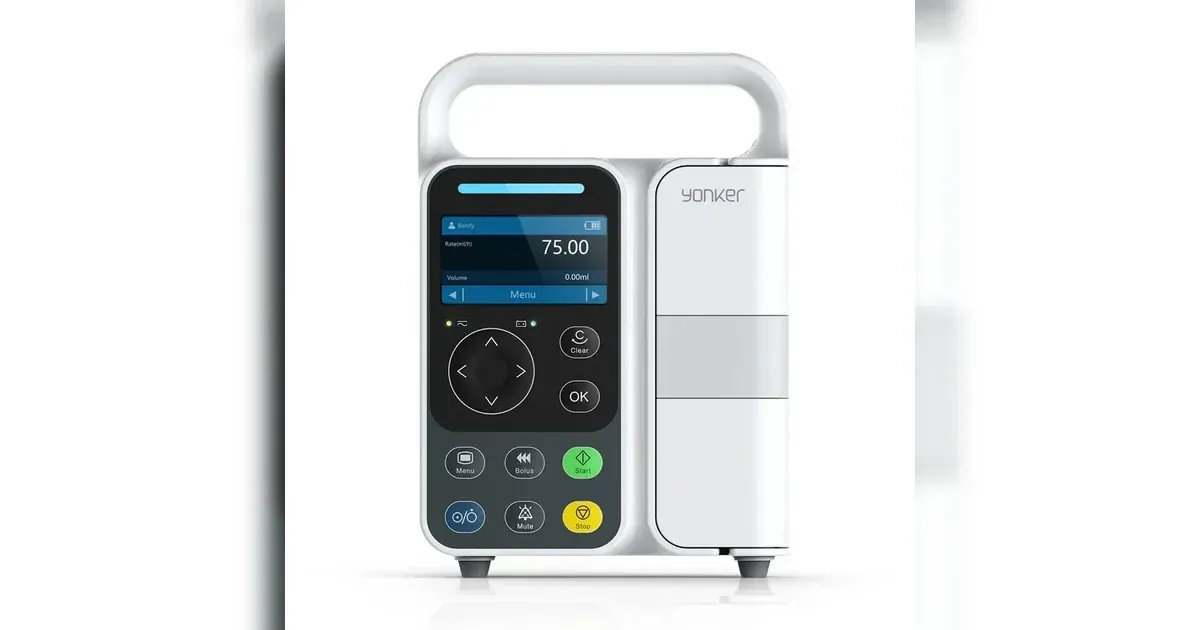
An infusion pump is a medical device designed to deliver fluids, medications, and other prescribed solutions into a patient's body at a controlled rate. It is widely used in hospitals, ICUs, operating rooms, emergency departments, and other clinical settings where accurate and continuous infusion is required. This guide explains infusion pump features, uses, safety functions, types, and important factors to consider when buying an infusion pump in Nepal.
An infusion pump is a medical device used to deliver fluids, medications, nutrients, or other prescribed solutions into a patient's body at a controlled and consistent rate. Unlike manual infusion methods where the flow may depend on gravity and adjustment of a roller clamp, an infusion pump provides electronically controlled delivery according to the settings entered by trained healthcare professionals. Infusion pumps are commonly used in hospitals, intensive care units, operating rooms, emergency departments, pediatric units, and other clinical environments where controlled intravenous therapy is required. MEDISYS describes its infusion pump as suitable for clinical treatments requiring continuous and precisely controlled infusion at a constant rate.
Modern infusion pumps can provide several operating modes and safety functions designed to support controlled fluid delivery. Depending on the model, features may include volume mode, drip mode, volume/time mode, bolus or purge functions, adjustable flow rates, KVO operation, occlusion detection, air-bubble detection, battery backup, and audio-visual alarms. For example, the MEDISYS infusion pump supports multiple infusion modes and incorporates ultrasonic air detection and adjustable occlusion-pressure detection, while Beyond's BYS-820 series offers flow rates up to 1200 ml/h and voice alarm functions.
When choosing an infusion pump in Nepal, healthcare facilities should consider the required clinical application, flow-rate range, infusion accuracy, compatible IV sets, alarm functions, battery backup, display, KVO function, occlusion detection, air-in-line detection, maintenance requirements, and technical support. Different hospitals and departments may have different requirements, so the pump should be selected according to the intended application and facility protocols. AR Surgical Suppliers offers infusion pump options from Yonker, Beyond, and MEDISYS, allowing healthcare facilities to consider different configurations based on their requirements.
What Is an Infusion Pump?
An infusion pump is an electrically operated medical device that controls the delivery of fluids through an intravenous or other appropriate administration set. The pump regulates the flow according to the programmed parameters and helps provide a more controlled rate of delivery.
Infusion pumps are generally operated by trained healthcare professionals. The type of fluid or medication, delivery rate, volume, and duration are determined according to the patient's clinical requirements and the relevant medical protocol.
How Does an Infusion Pump Work?
An infusion pump works by mechanically controlling the movement of fluid through an IV administration set. Depending on the pump design, a peristaltic mechanism or another pumping system moves the fluid through the tubing at the programmed rate.
The healthcare professional enters parameters such as flow rate and target volume into the pump. The device then monitors its operation and can provide alarms if it detects certain problems, such as occlusion, air in the line, low battery, completion of infusion, or other system conditions. The exact functions vary between models.
Key Features of an Infusion Pump
One important feature is precise flow-rate control. Infusion pumps allow healthcare professionals to set the desired delivery rate within the pump's specified operating range. MEDISYS, for example, lists flow-rate settings extending up to 1200 ml/h for several IV-set configurations, while Beyond's BYS-820 series also lists a rate range of 1–1200 ml/h.
Another important feature is the availability of different infusion modes. Depending on the model, these can include volume mode, drip mode, volume/time mode, bolus, and purge functions. These modes provide flexibility for different clinical applications and allow the pump to be configured according to the prescribed infusion requirements.
Modern infusion pumps may also incorporate occlusion detection and air-in-line detection. MEDISYS lists upstream and downstream pressure detection with adjustable occlusion levels and ultrasonic air detection, including detection of air bubbles above a specified threshold. These monitoring functions are intended to alert healthcare personnel when certain conditions are detected.
Common Uses of Infusion Pumps
Infusion pumps are widely used in hospitals and other healthcare facilities where fluids or medications need to be delivered at a controlled rate. They may be used in intensive care units, emergency departments, operating rooms, medical and surgical wards, pediatric departments, and other appropriate clinical settings.
They can be useful when the required infusion rate needs to remain consistent over a defined period. The exact application depends on the type of infusion pump, the prescribed therapy, and the clinical protocol of the healthcare facility.
Types of Infusion Pumps
Infusion pumps are available in different designs for different clinical requirements. A standard volumetric infusion pump delivers fluids through compatible IV tubing and allows healthcare professionals to program parameters such as flow rate and volume.
A syringe pump uses a syringe to deliver smaller quantities of medication or fluid at a controlled rate. Syringe pumps are particularly useful when precise delivery of relatively small volumes is required. MEDISYS and Beyond also offer syringe-pump products alongside their infusion-pump ranges.
There are also specialized infusion systems and multi-pump configurations designed for clinical environments where several pumps may be used together. Beyond, for example, lists infusion stations that can combine multiple pumps in a centralized system depending on the model.
Safety Features of Infusion Pumps
Safety features are an important consideration when selecting an infusion pump. Depending on the model, alarm systems may monitor conditions such as air in the line, upstream or downstream occlusion, door opening, completion of infusion, low battery, free flow, drip detection errors, and other operating faults.
The MEDISYS infusion pump includes acoustic and visual alarms for a broad range of conditions and provides adjustable alarm-volume levels with a mute function. It also incorporates motor monitoring and self-testing functions.
These features do not replace proper clinical supervision. Infusion pumps should be used according to the manufacturer's instructions and the healthcare facility's established procedures.
Battery Backup and Portability
Battery backup can be particularly important in hospitals because infusion therapy may need to continue during movement between departments or temporary interruptions in mains power. The required battery duration depends on the model and operating conditions.
For example, MEDISYS lists up to approximately 10 hours of battery backup at 25 ml/h after full charging for its infusion pump. Its listed weight is approximately 1.7 kg, making it suitable for movement within a clinical environment.
When purchasing an infusion pump, facilities should check the actual battery capacity, expected operating time, charging time, and whether the battery is replaceable or serviceable.
Important Specifications to Consider
Important specifications include the flow-rate range, flow-rate increment, infusion accuracy, compatible IV-set types, preset volume, total volume, KVO range, bolus function, occlusion-pressure range, air-bubble detection, alarm system, battery backup, display, and power requirements. These specifications can vary significantly between models.
For example, MEDISYS lists a flow-rate deviation of no more than ±5% after calibration, adjustable KVO of 1–5 ml/h, preset volume up to 9999.9 ml, and multiple IV-set configurations. Beyond's BYS-820 series lists 20- and 60-drop/ml IV-set compatibility and flow rates up to 1200 ml/h.
How to Choose an Infusion Pump in Nepal
When selecting an infusion pump in Nepal, first identify the clinical environment in which it will be used. A general hospital ward may have different requirements from an ICU, operating room, emergency department, or pediatric unit.
Next, consider the required flow range and accuracy, compatible IV sets, alarm functions, air detection, occlusion monitoring, battery backup, display, ease of operation, and maintenance requirements. It is also important to consider the availability of replacement accessories, technical support, warranty, and servicing in Nepal.
Yonker, Beyond and MEDISYS Infusion Pumps
AR Surgical Suppliers offers infusion pump options from Yonker, Beyond, and MEDISYS. These brands provide different medical pump configurations and specifications, allowing healthcare facilities to select equipment according to their operational requirements.
Beyond's current medical-pump range includes the BYS-820 and BYS-820D infusion pumps, with the BYS-820D additionally offering a drug library with more than 2,000 records according to the manufacturer's product information. MEDISYS offers an infusion pump with multiple infusion modes, adjustable occlusion detection, ultrasonic air detection, battery backup, and extensive alarm functions.
Yonker also manufactures hospital infusion and syringe-pump equipment. Its medical-equipment portfolio includes infusion and syringe pump products with features such as controlled flow delivery, alarm functions, and compatibility with clinical pump systems depending on the model.
Infusion Pump Maintenance and Care
Proper maintenance is important for reliable infusion-pump operation. The pump should be cleaned and inspected according to the manufacturer's instructions, while IV-set components and other consumables should be used according to their intended specifications.
Healthcare facilities should regularly check the pump's alarms, battery condition, tubing mechanism, sensors, display, power connection, and other relevant functions. Calibration and servicing should be performed according to the manufacturer's recommendations and facility maintenance procedures.
Infusion Pump in Nepal
An infusion pump in Nepal can be an important piece of equipment for hospitals, clinics, ICUs, emergency departments, operating rooms, and other healthcare facilities requiring controlled infusion delivery. Selecting the right model requires consideration of flow rate, accuracy, compatible IV sets, safety alarms, battery backup, monitoring functions, and service support.
AR Surgical Suppliers supplies medical equipment including Yonker, Beyond, and MEDISYS infusion pumps. Healthcare facilities in Kathmandu and across Nepal can select the appropriate pump based on their clinical requirements and technical specifications.
Conclusion
An infusion pump provides controlled and consistent delivery of fluids or medications and is widely used across different hospital and clinical environments. Features such as adjustable flow rates, multiple infusion modes, occlusion detection, air-in-line detection, alarm systems, KVO functionality, and battery backup can support controlled infusion management when used by trained healthcare professionals.
For anyone looking for an infusion pump in Nepal, it is important to compare the required specifications, safety functions, compatible IV sets, battery performance, maintenance requirements, warranty, and technical support. AR Surgical Suppliers offers Yonker, Beyond, and MEDISYS infusion pump options for healthcare facilities with different clinical requirements.