
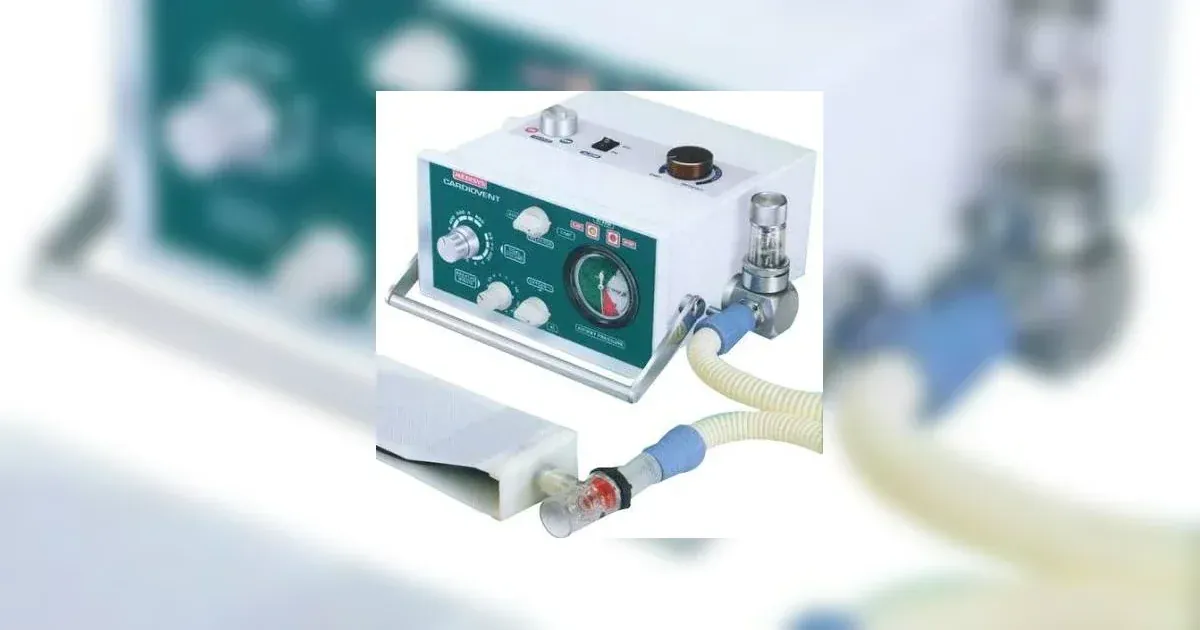
The MEDISYS Cardiovent Transport Ventilator is a compact, pneumatically operated ventilator designed for emergency ventilation and patient transportation. It features controlled/assist-controlled operation, adjustable tidal volume and breathing rate, 40% and 100% oxygen concentration settings, audio-visual alarms, and a portable handle-cum-stand. This guide explains its features, uses, specifications, and important considerations when choosing a transport ventilator in Nepal.
The MEDISYS Cardiovent Transport Ventilator is a portable ventilator designed for emergency ventilation and patient transportation. MEDISYS describes Cardiovent as a handy and portable ventilator intended for use during casualty situations and transportation of patients. Its design focuses on straightforward operation, with graduated controls for tidal volume and breaths per minute, helping healthcare personnel make the required adjustments efficiently in emergency and transport environments. The ventilator is pneumatically operated and time-cycled, with controlled and assist-controlled modes of operation.
The Cardiovent provides adjustable tidal-volume settings in steps of 50, 200, 300, 400, 500, and 800 cc, while the breathing-rate settings are available in steps of 10, 15, 20, 30, and 40 breaths per minute. It supports oxygen concentrations of 40% and 100%, and its plug-in oxygen flowmeter has a flow range of 1–15 LPM. The system also incorporates audio-visual alarms for low inspiratory pressure, source-pressure failure, and patient disconnection, as well as an alarm for high inspiratory pressure beyond 40 cmH₂O.
For healthcare facilities considering a MEDISYS Cardiovent Transport Ventilator in Nepal, factors such as ventilation requirements, portability, gas supply, alarm functions, operating controls, accessories, maintenance, and service support should be considered. The Cardiovent has a control module measuring approximately 25 × 23 × 13 cm and weighs around 5.5 kg. Its handle-cum-stand is designed to make transportation easier and can also support the unit at a slanted angle for convenient access to the controls. Because ventilators are specialized medical devices, operation, settings, and patient management should be handled by appropriately trained healthcare professionals.
What Is the MEDISYS Cardiovent Transport Ventilator?
The MEDISYS Cardiovent is a portable transport ventilator designed for emergency ventilation and patient transportation. MEDISYS categorizes it under its Emergency & Transportation range and describes it as a handy, portable, and easy-to-operate ventilator for casualty and patient-transport applications.
The device uses a pneumatically operated, time-cycled system and can operate in controlled or assist-controlled ventilation. It is designed to work with oxygen or air supplied at approximately 60 PSI, according to the manufacturer's specifications.
Key Features of MEDISYS Cardiovent
The Cardiovent is designed around relatively straightforward controls for tidal volume and breathing rate. Its graduated tidal-volume settings range from 50 cc through 800 cc, while the available breathing-rate settings range from 10 to 40 breaths per minute. This makes the controls easy to identify and adjust according to the requirements of the clinical situation.
The ventilator supports 40% and 100% oxygen concentration and includes a plug-in oxygen flowmeter with a 1–15 LPM flow range. These specifications allow the unit to be configured for different emergency and transport ventilation requirements under appropriate clinical supervision.
Safety monitoring is another important part of the Cardiovent design. Its audio-visual alarm system provides indications for low inspiratory pressure, source-pressure failure, and patient disconnection, while high inspiratory pressure beyond 40 cmH₂O also triggers an alarm. The unit additionally has adjustable safety pressure relief from 0 to 50 cmH₂O.
Common Uses of Cardiovent Transport Ventilator
The MEDISYS Cardiovent is primarily intended for emergency ventilation and patient transportation. It can be relevant in casualty or emergency areas and during the movement of patients who require mechanical ventilatory support, subject to appropriate clinical assessment and trained operation. MEDISYS specifically places Cardiovent within its Emergency & Transportation product category.
Its portable construction can also be useful when ventilation support needs to accompany a patient during transfer between healthcare areas. The actual use of the ventilator, ventilation mode, settings, and patient circuit should always be determined by trained medical personnel according to the patient's condition.
Cardiovent Ventilator Specifications
The MEDISYS Cardiovent is classified as a flow generator and uses pneumatically operated, time-cycled controlled/assist-controlled ventilation. It uses oxygen or air at approximately 60 PSI, provides graduated tidal-volume settings of 50, 200, 300, 400, 500, and 800 cc, and provides breathing-rate settings of 10, 15, 20, 30, and 40 BPM. Oxygen concentration is specified at 40% and 100%, while the plug-in oxygen flowmeter has a 1–15 LPM range. The unit has adjustable safety pressure relief from 0–50 cmH₂O, a 9V battery, a control module measuring approximately 25 × 23 × 13 cm, and a weight of approximately 5.5 kg.
Portability and Handle-Cum-Stand Design
Portability is one of the important characteristics of Cardiovent. The unit weighs approximately 5.5 kg, while its compact control module measures around 25 × 23 × 13 cm. Its handle-cum-stand provides a practical way to carry the ventilator and can also act as a stand for positioning the unit at a slanted angle.
This design is particularly relevant to emergency transportation because the ventilator can be moved along with the patient and positioned for access to its controls. Proper securing of the ventilator and associated oxygen tubing and breathing circuit remains important during patient transport.
Accessories Supplied with Cardiovent
The manufacturer's listed accessories include the ventilator, breathing circuit, plug-in type oxygen flowmeter, pre-fixed oxygen pressure regulator, high-pressure tubing with end fittings, and pipeline adaptor. These components support the ventilator's intended setup and connection to an appropriate gas source.
Before purchasing, healthcare facilities should confirm the exact accessories included with the particular unit being supplied, as configurations and included components can vary.
What to Consider Before Buying a Transport Ventilator in Nepal
When selecting a transport ventilator in Nepal, healthcare facilities should consider the required ventilation application, available gas source, ventilation controls, tidal-volume range, breathing-rate settings, oxygen concentration options, alarm functions, portability, accessories, and after-sales service.
For the Cardiovent specifically, buyers should verify the required oxygen or air supply, compatible breathing circuit and accessories, operating specifications, warranty, and availability of technical support. Since this is specialized respiratory equipment, the product should be operated by trained healthcare personnel and used according to appropriate clinical protocols.
Cardiovent Ventilator Safety and Maintenance
Proper maintenance is important for reliable operation of any transport ventilator. The breathing circuit, tubing, connectors, gas supply connections, and other components should be checked according to the manufacturer's instructions and the healthcare facility's maintenance procedures.
The ventilator should be kept clean and protected from conditions that could damage its pneumatic or mechanical components. Regular inspection and servicing by appropriately qualified personnel can help identify wear, connection problems, or other technical issues before the device is required in an emergency.
MEDISYS Cardiovent Transport Ventilator in Nepal
The MEDISYS Cardiovent Transport Ventilator in Nepal can be considered by hospitals, emergency departments, healthcare facilities, and other professional medical settings that require a portable ventilator for emergency or patient-transport applications. Its compact 5.5 kg design, straightforward graduated controls, multiple alarm functions, and oxygen concentration options are among its notable characteristics.
For buyers in Kathmandu and across Nepal, it is important to confirm the exact model, specifications, accessories, warranty, and technical support available with the supplier before purchasing. As a professional ventilator, its selection and use should be based on the requirements of the healthcare facility and the guidance of appropriately trained medical personnel.
Conclusion
The MEDISYS Cardiovent Transport Ventilator is a compact, pneumatically operated ventilator designed for emergency ventilation and patient transportation. Its controlled/assist-controlled operation, graduated tidal-volume and breathing-rate settings, 40% and 100% oxygen concentration options, audio-visual alarms, adjustable safety pressure relief, and portable handle-cum-stand make it a specialized option for transport and emergency applications.
When choosing a Cardiovent Transport Ventilator in Nepal, healthcare facilities should consider the clinical application, gas supply, ventilation requirements, accessories, safety features, maintenance, and after-sales support. Proper operation by trained healthcare professionals is essential for safe and appropriate use.